




A new park is coming to Wrocław! The city has begun the process of acquiring 6 hectares of land from PKP, which is set to become a green space for three neighborhoods—Tarnogaj, Hub, and Przedmieście Oławskie.
Unobvious Beauty
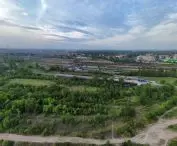
The triangular plot designated for Henrykowski Park —a green wedge in the southern part of the city—is bordered on one side by active railroad tracks and on the other by dense development. In the area around Prudnicka, Paczkowska, Henrykowska, and Jesionowa streets, one can find remnants of a linear railway layout and traces of the site’s former use as a construction waste dump. It is mostly overgrown with ruderal vegetation—that is, vegetation that grows on land altered by humans. The existing wasteland gives this space the potential to become a somewhat wild place, beautiful “in an unconventional way.”
© Google Maps
A natural source of inspiration would be the Schöneberger Südgelände railway park in Berlin, where “fourth nature”—that is, nature that slowly (and in its own way) colonizes degraded areas—reigns supreme, as well as the now-iconic High Line in New York. Will Wrocław dare to follow a similar path?
An example of a creative approach to adapting urban brownfields is the new High Line park in New York City, where nature, having emerged through natural vegetation succession on a disused elevated railway, became the starting point for creating a new park and a visionary adaptation of post-railway structures. The vegetation composition, designed by Dutch perennial designer Piet Oudolf, echoes the site’s pre-adaptation state in terms of aesthetics, structure, and species selection. Ecological succession on the decommissioned railway viaduct thus served as inspiration for spectacular landscape architecture solutions aimed at making a space—which was naturally inaccessible, dangerous, and reclaimed by nature —available to the public. The park, inspired by railway biotopes, is an expression of an original quest for a new, appropriate (park-like) function, making it accessible to residents while preserving the form of the engineering structure. The role of synanthropic vegetation—which appears spontaneously in anthropogenic environments that have been heavily transformed or even degraded—cannot be overstated. As in the case of another park on the site of a decommissioned steel mill (Landschaftspark Duisburg-Nord), spontaneous greenery serves as a humanizing, restorative, and aestheticizing factor that softens the industrial character of the site and, last but not least, constitutes an element of the place’s genius loci —and thus an emotional connection even to the most socially incongruous areas
— writes Kasper Jakubowski in the publication “The BeautyThat Is Not Obvious.”
Residents want green spaces!
The initiative to create a park here came from the residents—since 2019, the project has regularly appeared in the Participatory Budget, and each subsequent stage has garnered significant support. In 2020, a single-stage design competition for Henrykowski Park was even held, preceded by public consultations. However, no first prize was awarded at that time.
The reason was that none of the entries qualified for evaluation sufficiently addressed the existing context of the site or fully utilized its potential, nor did they take into account the significant constraints resulting from the current state of land use in the area covered by the competition
— the jury explained at the time.
Why has nothing happened with this site for seven years? The problem was land ownership —the City had a lease agreement with PKP, but in order to invest funds in creating a park, it needed a more secure legal title. Fortunately, the process has finally gotten underway—a few days ago, the City announced a conditional agreement to sell the land, and later this month, Wrocław Mayor Jacek Sutryk is set to sign a notarized deed with PKP representatives.
The city has already paid for the two cadastral parcels on which Henrykowski Park will be built. Wrocław will acquire nearly 6 ha of former railway land under perpetual usufruct. The sales agreement is currently conditional. The final formality to be completed is the official waiver of the right of first refusal, which is held by the National Real Estate Reserve (KZN). Once it receives the KZN’s response, Wrocław will immediately proceed to sign the final notarial deed with PKP. All signs indicate that this will happen in mid-July
— reports Bartosz Moch on the wroclaw.pl website.
The Municipal Greenery Authority has developed a design for the new park. However, any work must be preceded by remediation—that is, the removal of contaminants from the soil. The design calls for dividing the park into representative zones, educational and exhibition zones, recreational zones, sports zones, children’s zones, and a dog park. The intention is to preserve as much of the existing vegetation as possible and to introduce new plantings that will complement the park’s post-industrial character.
© Jacek Wojciechowski
Wrocław thus has the opportunity to create a unique linear park. What should be kept in mind when implementing such a project?
On post-industrial sites, land reclamation is essential. Every linear facility must be adapted to its surroundings, and its program must be interesting enough to encourage visitors. However, it is rare for even a not-entirely-well-planned structure to capture the essence of the space in which it was built. The benefits of introducing greenery and the opportunity to interact with it are irreplaceable in the city; at the same time, they elevate the status of a given place
— said landscape architect Kinga Kimic in an interview with A&B.
So we’re keeping our fingers crossed that this will work out in Wrocław as well. Who knows, maybe we’ll see a Polish High Line someday?